New Albany Architectural Review Rules for Home Sellers
August 27, 2026
August 27, 2026
"An application must be submitted and approved before any exterior improvement is undertaken." That single sentence, pulled straight from New Albany Links' design guidelines, sits underneath almost every pre-listing project a New Albany seller assumes they can knock out in a weekend. Fresh paint. A stained deck. A driveway patch before the photographer shows up. In most Central Ohio suburbs, that's a phone call to a contractor and a calendar note. In New Albany, it's a paperwork process that can take longer than the sale itself.
That gap between what sellers expect and what the review calendar actually allows is the real story right now, because New Albany's market has gotten fast enough to expose it. As of June 2026, homes here were selling at a median of 33 days on market with a 100% sale-to-list ratio, momentum tied in part to continued demand from nearby Intel-related job growth. A market moving that quickly rewards a seller who lists the moment their home is ready. It punishes a seller who assumed a quick refresh would be done in time and instead spent 60 to 90 days waiting on a committee.
Most sellers treat architectural review as a single gate: submit the plan, get a yes or no, move on. New Albany doesn't work that way for a meaningful share of its housing stock.
The city itself runs an Architectural Review Board with actual legal force. Any major or minor exterior change outside the Village Center requires a Certificate of Appropriateness, and the Design Guidelines and Requirements behind that certificate carry the effect of law under city code. That's layer one, and it applies citywide.
Layer two sits inside the subdivision. New Albany Links and New Albany Country Club each run their own Architectural Review Board or Architectural Review Committee, with guidelines specific to that community. New Albany Links spells this out directly: municipal approval does not constitute or override its own board's approval. Clearing the city doesn't clear the neighborhood.
For some sections, there's a third layer. The New Albany Communities Master Association acts as an umbrella body that oversees aesthetic consistency across the individual associations. If you don't know which section and lot number your home falls under, the Franklin County Auditor's parcel lookup is the place to start, because the guidelines that apply to your specific address depend on it.
None of this means every New Albany address carries three layers. It means the honest answer to "do I need approval" is never a guess. It's a lookup.
Not every improvement moves at the same pace. New Albany Links, whose published timelines are the most detailed available, puts most projects through a 30-day review, often faster. Two categories run much longer.
| Project type | Typical review window |
|---|---|
| Most exterior changes (fencing, roofing, structural additions) | About 30 days, often quicker |
| Exterior paint or solar installations | 60 to 90 days |
| Approval validity once granted | 6 months from issue |
Paint and solar take longer because they require more deliberation and, in many cases, an on-site review before anyone signs off. If a seller's pre-listing checklist includes a fresh coat on the trim, that's the exact category sitting in the slowest lane, at the exact moment a fast market rewards sellers who can move without delay.
The six-month expiration matters here too. An approval obtained in January doesn't help a seller who gets held up and doesn't finish the work until August. The clock doesn't pause for scheduling conflicts with a painting crew or a supply delay on materials.
Some sellers, once they understand the timeline, are tempted to just start the work and ask forgiveness later. New Albany Links' own compliance schedule makes that a bad trade: a $500 violation fee applies to structural changes made without prior approval, including additions, patios, and outdoor kitchens, and the same $500 applies to unapproved roof, siding, or window replacements. Smaller unapproved changes carry a $50 fee. Either way, the homeowner is still required to submit the paperwork and, potentially, undo work that doesn't conform.
There's a detail in the same guidelines that catches storm-damage repairs off guard: if a homeowner is filing an insurance claim, they're expected to get architectural board approval before accepting the insurance proceeds or signing a release. A seller repairing storm damage on a deadline, hoping to list the moment the check clears, can find the approval step sitting between them and their own settlement.
The paperwork obligation doesn't end at closing, either. Approval records for exterior modifications are meant to be kept by the homeowner and transferred to the next owner. A seller who made an unapproved change years ago and never resolved it isn't just carrying a personal risk. They're potentially handing an unresolved compliance issue to whoever buys the house next.
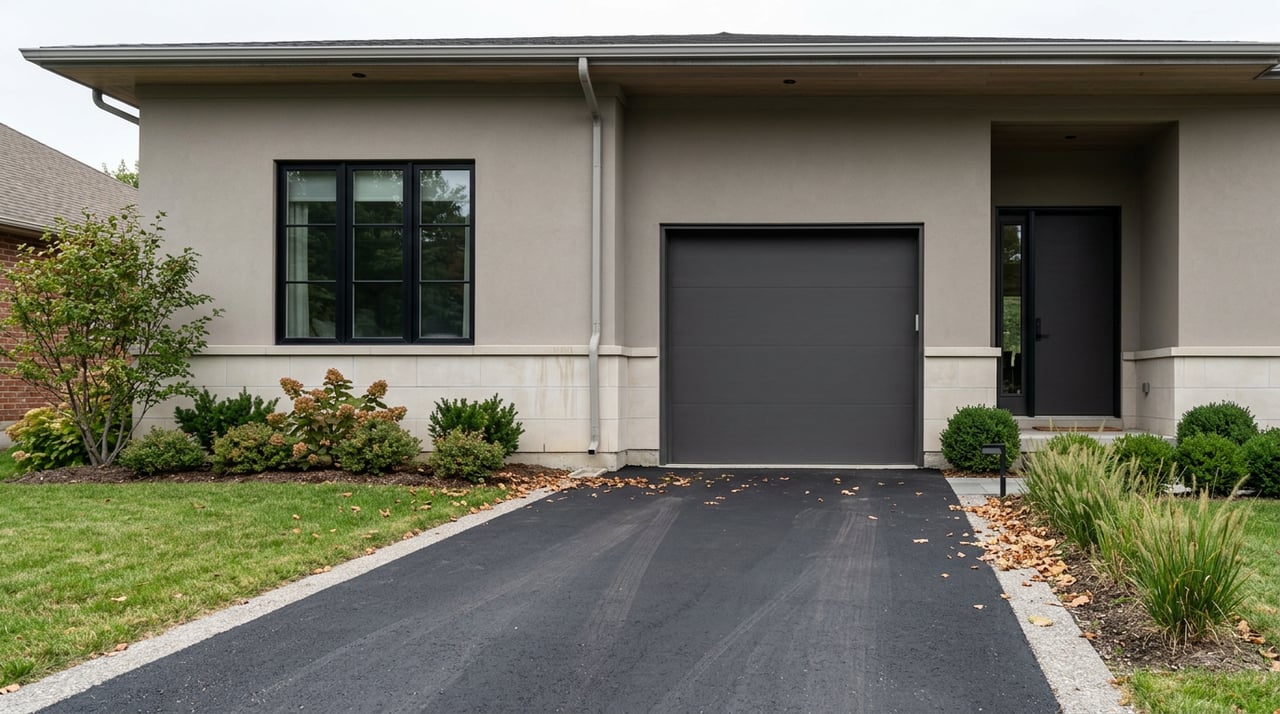
The design guidelines aren't vague suggestions dressed up in HOA language. They're specific enough to override a seller's own taste. Brick and stone can never be painted, full stop, regardless of what the seller thinks would modernize the exterior. A defined list of color families, including pastels, coastal tones, deep yellows, and rust or orange shades, is generally not approved for siding or trim. Local contractor guidance for the city notes that driveways are expected to be black asphalt, not concrete, which rules out a common and comparatively cheap curb-appeal fix that would be unremarkable almost anywhere else in Central Ohio.
None of these rules exist to slow sellers down for its own sake. They exist because New Albany's whole market identity, the one driving prices well above the Central Ohio median, depends on a level of visual consistency that a single off-guideline driveway or a painted brick facade would chip away at. The restriction and the premium are the same story.
Put the pieces together and the timing problem becomes concrete. A seller decides on a fresh exterior paint job because it will help the home show better. They contact a painter, get a quote, and plan to list once the work is done. If that home sits inside an HOA with its own board, the paint submission alone can take 60 to 90 days before work can even begin, not finish. Meanwhile, comparable homes in New Albany were going under contract in a median of 33 days as of June 2026. A seller planning around a two-week paint job, when the actual review window is measured in months, isn't just behind schedule. They've missed the fast window entirely and are now listing into whatever the market looks like two or three months later.
This is the argument for building the review timeline into the listing plan from day one, not discovering it after a contractor's already been booked. A pre-listing walkthrough that identifies which exterior changes actually need approval, and which don't, is the difference between a head start and a delay.
Does getting city approval mean I don't need HOA approval too? No. New Albany Links states plainly that municipal approval does not override its own board's approval. The two processes run separately, and clearing one doesn't clear the other.
How do I find out which review layers apply to my specific address? Start with your section and lot number, which you can find through the Franklin County Auditor's property search. From there, your subdivision's HOA can confirm whether a master association layer applies on top of its own guidelines.
A seller who understands the review calendar before listing has an advantage that shows up in weeks saved, not just paperwork avoided. If you're planning to sell in New Albany and want a pre-listing timeline built around what the design review actually allows, Guided Property Sales can walk through your specific address, your HOA layers, and what needs approval before your first showing is ever scheduled. Request your VIP home valuation to start that conversation now.
This article is general information, not legal, tax or financial advice. Consult a qualified professional about your situation.

We pride ourselves in providing personalized solutions that bring our clients closer to their dream properties and enhance their long-term wealth. Contact us today to find out how we can be of assistance to you!